Pech Merle Cave, a major tourist site
The Pech Merle cave is one of the most popular tourist attractions in the Célé Valley, although it is less well-known than Lascaux, located in the neighbouring Vézère Valley in the Dordogne.

The excessive publicity that these two caves received upon the discovery nearly led to their destruction due to human pollution. Pech Merle therefore adapted its visiting schedule to protect its invaluable artistic heritage. The number of visitors is limited to 25 per tour, and departures are spaced 20 minutes apart. This ensures that no more than 75 visitors are in the cave at any one time: the third group begins its tour as soon as the first finishes, and the second halfway through.
These measures minimise the impact of humidity from respiration and body heat. The guide also manages the lighting during commentary to prevent the air from overheating and the accumulation of humidity, a crucial factor in preserving the cave’s fragile environment and avoiding the fate of Lascaux. During peak season, the ticket office limits reservations to 10 per visit. This ensures fairness by reserving the remaining 15 tickets for on-site availability, thus offering an equal opportunity to those who were unable to book online or by phone.
The story of the discovery of the Pech Merle cave reads like a tale straight out of a great French novel!
The discovery of Pech Merle
The Pech Merle cave was indeed discovered in 1922 by two teenagers exploring an underground gallery where people had taken refuge to escape the atrocities of the French Revolution.

Cave paintings – Ibex
They stumbled upon the cave entrance by chance. Driven by curiosity, they ventured deeper into the galleries and, by the dim light of their torches, discovered cave paintings that were later dated to between 35,000 and 20,000 years ago.
These remarkable paintings depicted a wide variety of animals, including horses, mammoths, bison, and bears, as well as human figures, footprints, and the extremely rare “negative handprints.”
Pech Merle is indeed one of the few caves adorned with rock art to feature representations of human beings. Research continued after the cave was opened to the public, and in 1949, the original entrance was discovered. It now serves as the exit for guided tours.
Modifications were indeed necessary to accommodate visitors, who, unlike the artists who decorated the cave, no longer need to crawl to access the depth of the galeries!
Galerie Préhistorique – Mammoths’ Chapel
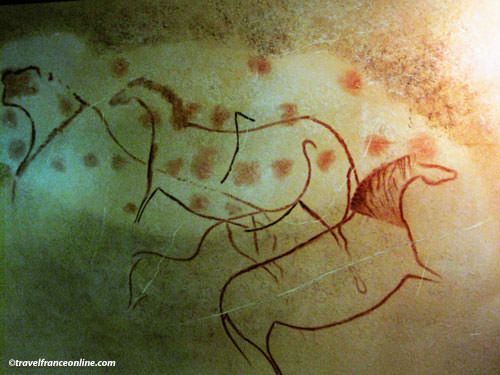
The guided tour of the Pech Merle cave takes you through a succession of chambers and galleries.
The exploration begins at the cave’s upper level, where the Prehistoric Gallery, the Chapel of the Mammoths, reveals a spectacular 7-metre-long frieze depicting mammoths and bison.
One cannot help but admire the ingenuity of the artist who skillfully used the natural irregularities of the rock to sculpt the mammoth.
With just two strokes, he sketched the animal’s back and belly, allowing the natural contours of the rock to form the legs, head, and torso.
The result is simply spectacular!
You cannot help but be moved, imagining this distant ancestor moving through the darkness of the cave, illuminated only by the dim glow of his oil torch, carefully searching the rock walls for the shapes upon which to base the outline of the mammoth.
What thoughts and emotions ran through his mind as he worked, preparing his pigments in the silent depths of the cave?
And, what would he think if he knew that his creations had survived millennia and were considered masterpieces of cave art?
Salle des Disques – Hall of Discs

The mastery displayed in the engraving of the bear is truly extraordinary. The artist demonstrated exceptional skill in engraving the bear, and once again exploited the concave contours of the rock to create an illusion of perspective and depict the animal’s head with astonishing precision. Such expertise testifies to a profound understanding of form and perspective.
Pech Merle cave – Negative Hands
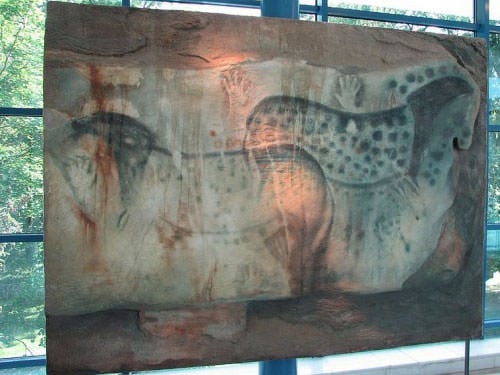
The Pech Merle cave is world-renowned for its remarkable “negative” handprints, discovered in its lower section. Surprisingly, these prints were later superimposed on a existing frieze depicting horses.

The process for creating the “negative hands” involved pressing the hand flat against the rock face and then applying coloured liquid pigments using a primitive blowgun. Once the hand was removed, the imprint appeared on the wall.
The symbolism of these “negative hands” remains one of the mysteries of cave art. A recent theory suggests that these prints, with their slender and delicate fingers, might be female rather than male. If confirmed, this theory could revolutionise our understanding of cave art.
Imagine shamans or perhaps priestesses, venturing into the depths of the earth, equipped with rudimentary torches to illuminate the dark galleries. Imagine their senses heightened as they explored the vast caverns, discovering extravagant and sometimes unsettling rock formations. Despite any fear or apprehension they might have felt, they persevered, driven by artistic or religious motivations. Their identity remains a mystery, lost in the mists of time. Without written records or oral traditions to shed light on them, we are indeed left to ponder the secrets of their creation.
Combel Gallery
Another painted gallery, connected to the Combel Gallery (the current exit, but the original entrance to the cave), has been discovered.
However, it remains inaccessible to the public, as it requires crawling along a 40-metre-long and 1-metre-wide corridor!
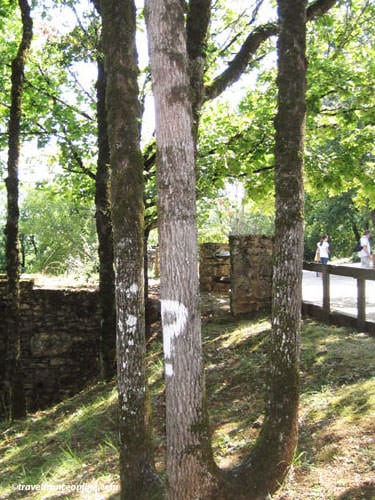
When the archaeologists arrived in this gallery, they discovered an astonishing natural phenomenon: the roots of an oak tree that had penetrated the cave ceiling and anchored themselves in its floor.
You will find the adventurous tree near the cave entrance as its trunk is marked with a question mark to help you locate it.
The Pech Merle cave certainly holds other underground treasures just waiting to be discovered.
Musée Amédée Lemozi
The price of the guided tour of the Pech Merle cave includes access to the Amédée Lemozi Museum, which offers a comprehensive journey through the prehistoric heritage of the Quercy region.
The museum indeed houses an impressive collection of tools, weapons, bones, and artefacts from the Lower Palaeolithic period, unearthed in the numerous local prehistoric sites, and provide valuable insights into the daily lives and practices of early humans.
The remarkable statuette of the Neolithic Mother Goddess, also known as the Universal Progenitor is undoubtedly the museum’s highlight. This exceptional sculpture, discovered in Capdenac-le-Haut, dates back to 3,150 BC. The museum is also a vital research centre, where artefacts are examined, analysed, and catalogued by experts, contributing to a deeper understanding of the rich prehistoric heritage of the Quercy region.
Department of Lot – Cabrerets
Coordinates: Lat 44.507371 – Long 1.644181
Photos via Wikimedia Commons: Negative hand Public domain